Saying Goodbye

At some point, someone decides that it is time to explain. Grief does not settle in the same way for every mind.
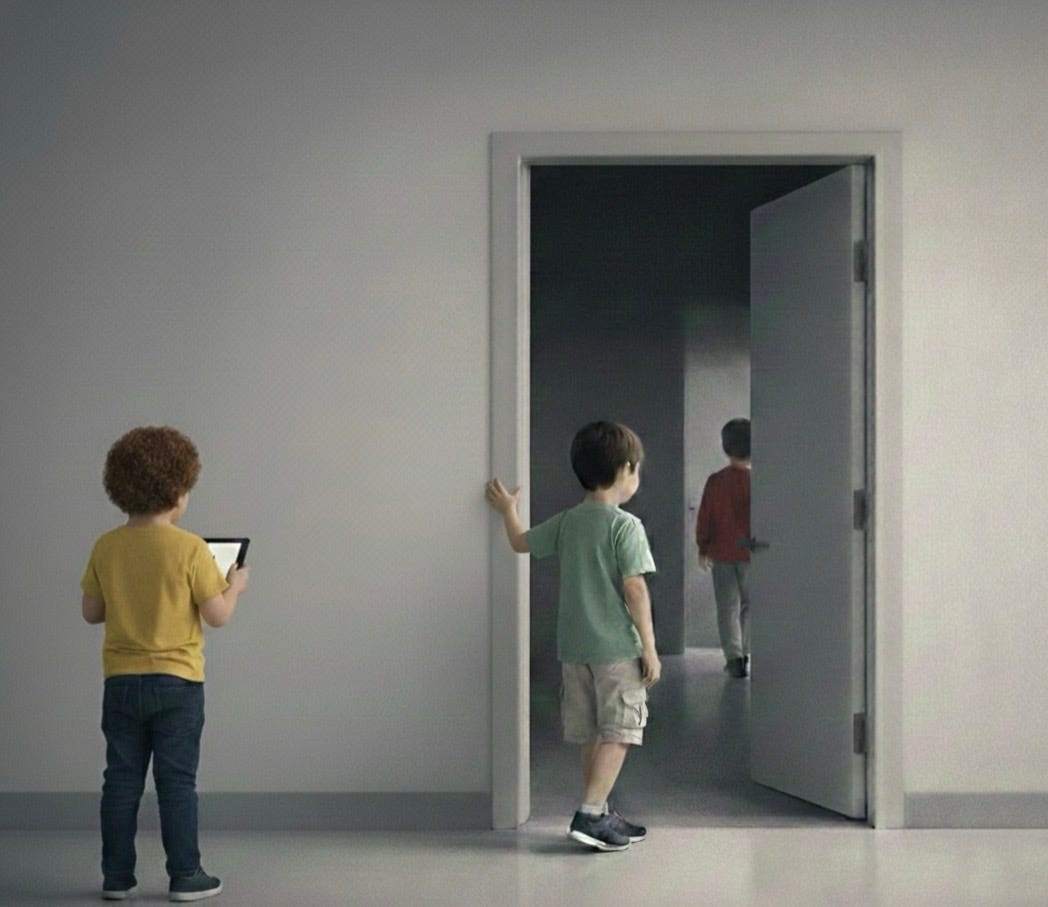
“Saying goodbye”
Not because anything has happened yet, but because something will. The decision is framed as care. As honesty. As preparation. There is an assumption that naming what is coming will help it land more gently when it arrives.
Explanation is treated as a moral good. A way of steadying the ground in advance.
But explanation assumes a shared capacity to receive what is said. It assumes that knowing what is happening will help everyone orient themselves to it in roughly the same way.
That assumption does not always hold.
In some families, the same event occupies multiple cognitive spaces at once. The words used to describe it are identical, but the meaning they carry is not. The difference is not emotional. It is structural.
A visit changes its status. The destination remains the same. The routine remains recognisable. What has altered is that one version of the visit contains an ending, and the other does not.
This is where the difficulty begins.
There are children for whom “last time” is a concept that can be grasped. It can be anticipated, examined, and returned to. The explanation becomes an object of thought. It is turned over, tested for coherence, replayed in the mind.
Questions arise, not always because answers are needed, but because the mind is trying to place the information somewhere stable.
For these children, explanation does not soften what is coming. It sharpens it. The future becomes populated with imagined moments of absence. The goodbye is rehearsed long before it happens.
There are children for whom “last time” does not settle in the same way. The explanation is heard, but it does not attach. It remains abstract, peripheral, or unstable. Meaning drifts in and out of focus.
For these children, the explanation hovers. It is neither fully taken in nor fully rejected. The goodbye does not arrive when it is spoken. It arrives later, often without warning, when the absence is encountered in an ordinary moment.
And there are children for whom “last time” is not a usable category at all. The explanation cannot be integrated, no matter how carefully it is offered. Language does not bridge the gap between presence and absence. When the loss occurs, it is not understood as an ending. It is registered as disappearance.
For these children, there is no goodbye in the conventional sense. There is only the fact that someone who was there is no longer there. No reason attaches to that fact. No narrative follows it.
The same sentence cannot be true in the same way for everyone who hears it.
This is rarely acknowledged. Grief is commonly framed as an experience that can be guided, supported, and shared. We speak of helping children understand. We speak of saying goodbye as if it were a single act, completed once, and then carried forward together.
But saying goodbye assumes a shared moment of recognition. It assumes that the ending is understood as an ending at the time it occurs. It assumes that the goodbye, once said, belongs to everyone equally.
In families where cognitive processing diverges, that assumption collapses.
There may be no final moment that lands for everyone. No shared ritual that carries the same meaning across different minds.
Instead, there are parallel versions of the same loss, unfolding at different speeds, in different forms, or not unfolding at all.
To explain fully is to risk overwhelming some children with information that destabilises rather than supports. To explain partially is to risk delaying understanding in ways that may later be painful. To withhold explanation altogether is to accept that some children will experience loss without context, while others carry knowledge alone.
There is no sentence that satisfies all of these conditions.
The decision, then, is not about honesty versus avoidance. It is about how uneven truth must sometimes be, and who bears the consequences of that unevenness.
Someone must hold the contradiction.
Some children will understand too much and carry it as anticipation, anxiety, or fixation. Others who do not yet understand carry it later, often without preparation. There are others who will never understand, and carry only the absence itself.
The adult carries all versions at once. This requires choosing what can be said, and what cannot.
Their own loss does not arrive with the same space.
This is rarely named as labour. It is treated instead as intuition, or parenting instinct, or simply “doing one’s best.” But it is work nonetheless. It requires holding knowledge in reserve, sometimes for years, without resolution.
It also requires restraint.
There is a strong cultural impulse to believe that more explanation is always better. That clarity reduces harm. That naming reality brings relief.
In practice, explanation can be a blunt instrument. It can introduce distress without providing stability. It can demand cognitive work at a moment when capacity is already strained. It can insist on understanding as a prerequisite for care.
In some cases, choosing not to explain further is not avoidance. It is protection. It is an acknowledgment that meaning cannot be forced to arrive on schedule.
This runs against many professional narratives about grief and communication. It sits uneasily with guidance that treats explanation as universally beneficial. It resists the idea that there is a correct way to say goodbye, provided the right words are chosen.
In reality, words do not operate independently of the minds that receive them.
The absence of a shared goodbye is often misread as failure. As a missed opportunity for closure.
But closure itself is a construct that assumes uniformity of experience. It assumes that recognition brings a kind of psychological completion.
For some families, absence does not announce itself. It settles gradually. It becomes background. The world continues to function, even as something fundamental has shifted shape.
There may be no visible change at the moment the loss occurs. No behavioural marker that signals what has happened. No collective pause.
This can be unsettling to those who expect grief to look a certain way. It can be misinterpreted as lack of attachment or lack of understanding. It can invite judgment.
But what is actually present is difference, not deficit.
The goodbye has not failed to happen. It has happened unevenly.
Some children will carry it as memory. Some will carry it as confusion. Some will not carry it at all, only the altered pattern of their days.
None of these responses are incorrect. They are responses to the same event filtered through different nervous systems.
What unites them is that someone else must hold the whole picture.
The adult must remember what cannot be remembered by everyone. They must absorb the fact that there will be no single story of what happened, no shared account to return to later.
This is not something that can be solved. It can only be managed.
Saying goodbye, in this context, is not a moment. It is a process that does not resolve into a shared understanding. It is a set of parallel adjustments, each moving at its own pace, some of which never converge.
The cultural expectation that grief should be collectively experienced obscures this reality. It assumes that meaning is transferable, and that loss can be integrated through explanation alone.
For some families, that assumption simply does not hold.
What remains instead is care without symmetry. Truth without uniformity. And a kind of quiet responsibility that sits outside most accounts of grief.
Not everyone will say goodbye in the same way. Some will not say it at all.
The task, then, is not to force a shared moment where none is possible, but to recognise that absence can be lived with differently, without demanding that it be understood in the same way.
That recognition does not offer comfort. It offers accuracy.
And sometimes, accuracy is the only thing that can be shared.
I didn't realize how much I needed to hear this until I read it.🌸
I was struck by how carefully this piece separates explanation from understanding. The idea that goodbye can unfold unevenly across different minds feels both psychologically precise and quietly humane.
What stayed with me most is the reframing of grief not as a shared moment but as parallel experiences held together by one person carrying the full picture. There’s a rare clarity here in naming responsibility without forcing resolution.