Take My Hand

There is a particular moment when an adult realises that the rules are no longer working. It does not arrive with drama. It is not announced. It comes quietly, often disguised as concern.
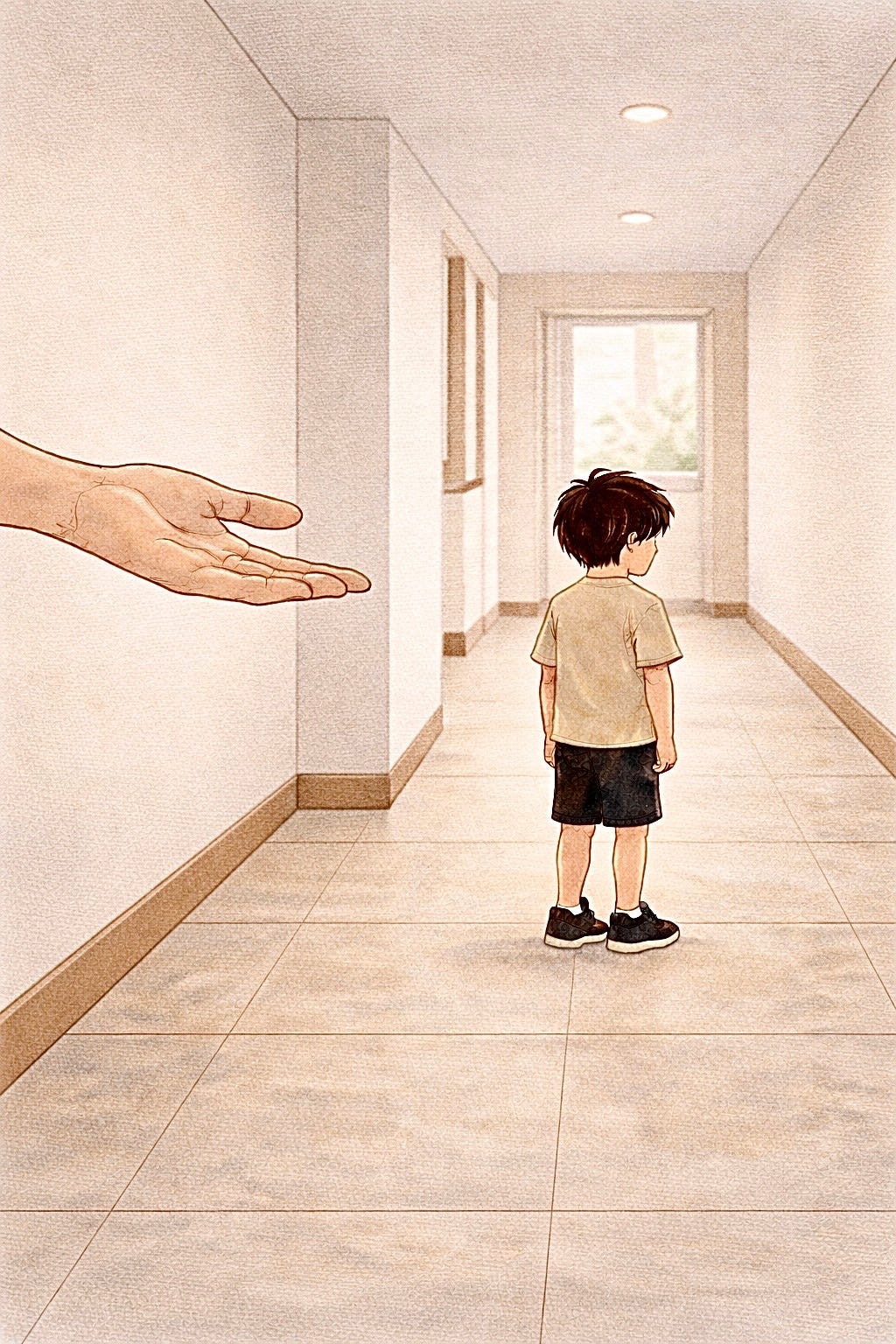
“Take my hand”
The adult has done what they were supposed to do. They have explained. They have warned. They have waited. They have offered choices that were not really choices. They have softened their voice and tightened it again. They have followed the script.
And still, the child does not move.
The moment is not one of rebellion. It is not refusal in the sense the adult understands refusal. It is a kind of immobility. A pause that does not resolve. A refusal without language. A body that has stopped responding to the future the adult is trying to usher it into.
This is usually the point where the adult reaches for the hand.
Not violently. Not roughly. Often gently. Sometimes with genuine care. The hand is offered as help, as reassurance, as presence. It is an attempt to bridge the gap between intention and outcome.
Take my hand.
The phrase carries weight. It sounds like safety. It sounds like guidance. It sounds like love.
It is also a demand.
Not always a conscious one. Not always a cruel one. But a demand nonetheless. It asks the child to move when they cannot move, to trust when trust is not available, to follow when following has become impossible.
The adult believes they are offering support. What they are offering is proximity with direction attached.
This is the moment that frightens the adult.
Because if the hand is not taken, the adult is left standing beside a child they cannot move. They are left present without leverage. They are required to remain while their authority fails to produce results.
For many adults, this is intolerable.
Not because they are unkind. Not because they want to dominate. But because authority has always been the structure through which they understand care. To help has meant to guide. To guide has meant to lead. To lead has meant to know where things are going.
Here, the adult does not know.
The child is not moving toward a future the adult can see. The child is not responding to reassurance, incentive, or warning. The adult’s hand is suspended in the air, unanswered.
This suspension is rarely recognised as a moment in its own right. It is experienced instead as delay. As resistance. As something that must be overcome.
The adult often does not notice how quickly an invisible audience appears. It is not a literal crowd. It is the idea of being seen. The idea of being the kind of adult who can get their child to move. The idea of competence, and what it looks like from the outside.
Even when nobody is watching, the adult feels watched. They feel time in their chest. They feel the consequence of this moment becoming a pattern. They imagine the child learning the wrong thing, though they cannot quite say what the wrong thing is. They imagine a future in which they are always standing like this, hand offered, child unmoved, and they imagine what that would say about them.
In that imagined future, presence is not enough. Presence looks like failure. So the adult begins to treat stillness as something that must be fixed.
The adult has been taught that hesitation is dangerous. That moments must progress. That standing still means falling behind. They have learned that care is active, visible, measurable. It looks like doing something.
Doing nothing feels like failure.
And so the pause becomes charged. Not with anger, necessarily, but with urgency. The adult begins to feel watched by the moment itself. They become aware of time passing, of expectations forming, of the quiet pressure to resolve what is unresolved.
This is often when the adult tightens.
The voice becomes more certain. The reasons become clearer. The consequences are outlined again. The adult is not trying to be cruel. They are trying to restore the conditions under which care makes sense to them.
They are trying to reintroduce a path.
But the child is not lost on a path. The child is standing still in a moment that cannot be crossed by force or persuasion.
The adult does not experience this as fear. They experience it as responsibility.
If they do not act, who will?
If they do not lead, what happens?
If they do not intervene, is that neglect?
These questions rise quickly. They justify urgency. They frame persistence as necessity. They turn hesitation into risk.
The adult reminds themselves that they are the adult. That this is what adults do. That they are here to make things happen.
And so the hand remains extended, now heavier. The offer of help hardens into expectation. The adult is still close, but no longer neutral. Their presence carries pressure.
From the child’s perspective, nothing has improved.
The hand has not changed the feeling in their body. The future still feels unreachable. The demand still exists, now dressed as concern. The child may pull away, not from the adult, but from the weight of what is being asked.
This withdrawal is often misread.
It is taken as defiance. As stubbornness. As opposition. The adult does not see that the hand itself has become part of the problem. Not because touch is wrong, but because it is being used to steer when steering is no longer possible.
The adult feels rejected.
This is another dangerous moment. The adult who feels rejected is tempted to recover authority by other means. The tone sharpens. The justification grows. The adult reminds themselves that they are in charge for a reason.
They tell themselves that letting this go would be irresponsible. That backing off would teach the wrong lesson. That authority must be maintained.
All of this happens while the adult remains convinced they are offering help.
The adult’s certainty is often real to them. It feels like clarity. It feels like moral duty. It feels like adulthood itself. The adult is not aware of how narrow their thinking has become. They do not hear their own voice tightening around a single outcome.
The adult has a picture in their mind of what should happen next. They hold it like a lifeline. They do not notice that the picture is now more important than the child. They do not notice that the picture is what is being protected.
This is why the extended hand becomes heavy. The hand begins as contact, but it ends up carrying the adult’s need for the moment to behave. The adult is not trying to control the child. They are trying to control what the moment says about them.
What the adult is struggling to tolerate is not the child’s distress. It is their own lack of control within proximity. They are close enough to feel responsible, but too close to pretend distance will solve it.
They want the child to take their hand so that the moment can move forward. They want movement not because movement is good, but because stasis exposes the limits of authority.
Stasis is unforgiving. It offers no narrative. No progress marker. No reassurance that things are unfolding correctly.
To stay beside a child without directing them requires something different.
It requires the adult to notice their own urgency without acting on it. It requires them to feel fear without translating it into motion. It requires them to remain present without making presence conditional on progress.
This is not passivity. It is not permissiveness. It is restraint.
Restraint is not often taught as a form of care. It is not easily visible. It does not produce immediate results. It offers no proof that the adult is doing their job.
What restraint looks like, from the inside, is often unbearable. The adult feels themselves not doing the thing they know how to do. They feel their own hands wanting to make the future happen. They feel the urge to narrate, to explain, to bargain, to add consequence, to add sweetness, to add firmness. Anything that creates motion.
Restraint means letting the moment remain unresolved without punishing the child for it. It means not turning the pause into a test. It means allowing the child’s stillness to exist without turning it into a verdict. The adult does not withdraw. The adult does not dominate. They stay close enough to be real, but they stop trying to make closeness do the work of control.
It is not calm. It is not easy. It is simply a refusal to make fear into action.
And so many adults avoid it.
The adult does not let go. They also do not pull.
They stand.
For many adults, this feels like abandonment of duty. It feels like doing nothing while something important is happening. It feels unsafe.
They worry that something will be missed. That harm will occur in the gap. That inaction will be judged more harshly than intervention.
But what is unsafe is not the stillness. What is unsafe is the adult’s belief that care must always move forward.
Sometimes, care looks like staying where you are.
The hand does not disappear. It is simply no longer attached to an outcome. It is no longer the bridge the child must cross. It is just a hand, near enough to be felt, not heavy enough to drag.
In this space, something subtle changes.
The child is no longer resisting movement. They are no longer being asked to go somewhere they cannot go. The adult is no longer performing certainty they do not feel.
The adult remains responsible. The adult remains present. Nothing about the relationship has been surrendered.
But the demand has loosened.
Nothing is solved. Nothing is fixed. The situation may remain exactly as it was.
But the moment has shifted.
The adult has learned something uncomfortable. That being alongside a child without directing them is frightening. That fear does not make the child wrong. It reveals how much of adult care is built on movement rather than presence.
The hand was never the problem.
The need for it to be taken was.
As a psychologist, I see this moment often when adults confuse movement with progress and feel responsible for resolving distress instead of tolerating it. Many children freeze not from defiance but from overload, and increased direction can unintentionally add pressure rather than safety. Staying present without pushing requires adults to regulate their own urgency first, which is far harder than offering solutions. When the adult can remain alongside without forcing an outcome, the child’s nervous system often finds its way forward on its own timeline. That kind of restraint is an active form of care, even though it rarely looks like action from the outside.